
In a region increasingly shaped by competition and coercion, such collaboration strengthens security without confrontation, builds capacity without dependency and promotes order without domination, points out Dr Kumar.

India and Japan will hold the fourth strategic dialogue on Saturday when Japanese Foreign Minister Katsuya Okada arrives in New Delhi, during which the two sides will discuss a wide gamut of issues, including civil nuclear cooperation and ways to enhance bilateral trade ties.
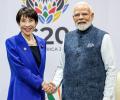
If they act now, they can reshape the strategic map of Asia without firing a shot. If they wait, the next opportunity will come only after a serious Taiwan Strait incident -- by which time the price will be far higher, and the room for boldness far smaller -- the opportunity may well be lost by then. The question is no longer whether this can or should be done, points out Varun Arya.
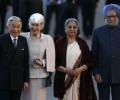
In recent years India-Japan relations have acquired rich economic content and strategic intents. Although the bilateral trade at $18 billion between the two countries is not very impressive and leaves much to be desired, the economic engagement between the two countries is both qualitatively and quantitatively noteworthy. India-Japan defence cooperation, however, has generated a lot interest among the strategic community in the context of rise of China. There has been a lot of speculation about India-Japan strategic partnership to hedge China, says Rup Narayan Das.

As Japan beefs up its defences against China, both New Delhi and Tokyo seem to have decided to re-energise their relationship to ensure a strategic balance in Asia. It is a clear signal that they may be ready to work together in containing if not confronting China, says Nitin Gokhale.
An India-Japan civil nuclear pact would be critical in signalling that they would like to build a partnership to bring stability to the region at a time when China is going all out to reward Pakistan with civilian nuclear reactors, says Harsh V Pant.
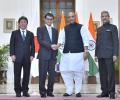
The India-Japan 2+2 dialogue added strategic heft to the special relationship in the wake of growing Chinese assertiveness on regional affairs, points out Dr Rajaram Panda.

The compulsion behind India and Japan to deepen security cooperation is in response to China's growing political and economic clout and its assertive behaviour in disputed areas. This has been the key driver for bringing both India and Japan closer in the domain of security cooperation, explains Dr Rajaram Panda.
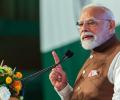
Prime Minister Narendra Modi on Friday said it is important for India and China to work together to bring stability to the world economic order as he asserted that New Delhi is ready to advance bilateral ties from a strategic and long-term perspective based on mutual respect, mutual interest and mutual sensitivity.

An India-Japan joint statement said the two leaders expressed serious concern over the conflict and the unfolding humanitarian crisis in Ukraine.
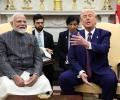
'Trump's aggressive stance towards China and preference for military posturing could shift the Quad's balance towards overt militarisation.'
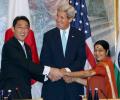
Amid China's growing assertiveness in South China Sea, India, Japan and the US at their first ever trilateral ministerial dialogue in New York.
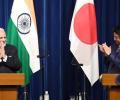
During the 13th annual summit, the two prime ministers reviewed developments in bilateral relations and explored new areas of cooperation, focusing on shared vision for peace and prosperity in the Indo-Pacific, where China is flexing its muscles.

Rediff.com's Dominic Xavier introduces you to the new look CCS, the most elite club in government.

Biden has been under attack from his opponents and the Republican Party for his immigration policies as hundreds and thousands of illegal immigrants enter the United States every month.

India and Japan on Thursday agreed to enhance military exercises and defence cooperation as the two countries emphasised that the bilateral special strategic and global partnership plays a crucial role in ensuring a free, open and rules-based Indo-Pacific, amidst China's aggressive behaviour in the region.

Prime Minister Modi, who is in Japan on a two-day visit to attend a summit of the Quad leaders at the invitation of his Japanese counterpart Fumio Kishida, penned an op-ed on the vibrant relations between India and Japan in the Yomiuri Shimbun.
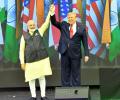
President Trump made these remarks on Monday while talking to reporters aboard Air Force One on his way back to Joint Base Andrews from Florida.
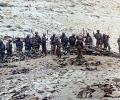
In the 15-year dataset, the researchers noted an average of 7.8 incursions per year even though the Indian government's estimates are much higher.

The India-Japan joint naval exercises are a strategic signal for China, observes Dr Rajaram Panda.
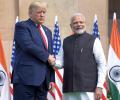
Prime Minister Narendra Modi and US President Joe Biden will have a substantive engagement on the sidelines of the Quad summit on Saturday, and the two sides will sign at least two agreements following the talks.

'While economic ties are making incremental progress, it is in the security and strategic domains that the India-Japan synergy is more compelling,' says Dr Rajaram Panda.
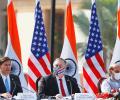
China is now the most significant strategic concern in Washington, as in most of the world's capitals, especially the democracies. Today, strategic autonomy has acquired a sharper definition: To ward off the Chinese challenge to India's territorial integrity, sovereignty and regional stature, observes Shekhar Gupta.
'Relations between India and Japan are robust and devoid of either shadow of history or any irritant.' 'In fact, there is plenty of warmth and goodwill earned over history. There are no negatives but only opportunities,' notes Dr Rajaram Panda.

Defence Minister Arun Jaitley leaves for Tokyo on Sunday evening for a security dialogue with Japan, a visit that acquires huge significance after North Korea's hydrogen bomb test on Sunday morning.
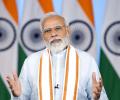
He said he will be visiting Tokyo at the invitation of his Japanese counterpart Fumio Kishida, and noted that in March 2022, he had hosted Kishida for the 14th India-Japan Annual Summit.

'Landed in Tokyo. Will be taking part in various programmes during this visit including the Quad Summit, meeting fellow Quad leaders, interacting with Japanese business leaders and the vibrant Indian diaspora,' Modi tweeted in both Japanese and English.
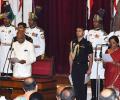
Sushma Swaraj startled Modi when she said she would like to be defence minister. That set the PM thinking, says Rajeev Sharma.

PM Modi articulated five action points that would serve the common interest of promoting peace and prosperity in the Indo-Pacific region.

Prime Minister Narendra Modi enjoys a close relationship with Shinzo Abe. For Abe, "a strong India is in the best interest of Japan, and a strong Japan is in the best interest of India."

Japan and India signed a 5-point action agenda to increase bilateral trade and investment between the two nations.

MEA Spokesperson Arindam Bagchi said the forthcoming Quad summit will provide an opportunity for the Quad leaders to exchange views about developments in the Indo-Pacific and contemporary global issues of mutual interest.

Announcing the hotline, the Chinese defence ministry said as agreed upon by the defence departments of China and Japan, the two sides have recently completed the construction of a direct telephone line for the sea and air liaison mechanism and will maintain communication on the arrangement for the launch.

Blinken will also attend a meeting of the foreign ministers of the Quad grouping and will hold bilateral talks with his Indian counterpart S Jaishankar in Delhi.
Ahead of the first of its kind dialogue involving India, Japan and the United States, a top American diplomat has said the trilateral talks make good strategic sense, but the idea that they are aimed at China's containment is "preposterous".

"We value our partnership with India, and we've been increasing it and doing a lot more, over time. They have the same security challenge, primary security challenger that we do, and it's real on their northern border," Admiral John Christopher Aquilino, commander of United States Indo-Pacific Command, told members of the House Armed Services Committee during a hearing on Indo-Pacific National Security Challenges.

US Vice President Kamala Harris would host a separate meeting with the prime ministers of three Quad countries -- India, Australia and Japan -- at the White House to discuss with them the important factors for democracies to go forward, officials said.
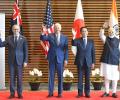
Chinese and Russian warplanes on Tuesday conducted joint air patrols over the Sea of Japan, the East China Sea and the West Pacific Ocean as the leaders of Quad held their in-person summit in Tokyo, in an apparent attempt to send a message of unity between Beijing and Moscow.

'India has a strong and proud tradition of strategic autonomy, and we respect that'

The UK government made its first major commitment to support UN Security Council reforms and India's permanent membership within it as part of a refreshed defence and foreign policy review tabled in Parliament on Monday.
 © 2026 Rediff.com - Advertise with us - Disclaimer - Privacy Policy - Sitemap - Feedback - About us - Terms of use - Grievances